

Defeat Before the Shot
On the pretext of the fate of a worn-out spectacle before a civilized Iran
The deployment of U.S. naval forces to the Persian Gulf, before being a purely military decision, is a political choice with calculated timing. Trump did not choose this moment by chance. Domestic pressures, accumulated crises in U.S. internal politics, deep social fractures, and the erosion of legitimacy have all pushed him toward once again turning foreign policy into a tool for marginalizing domestic problems. Within this framework, the naval show of force is less a message to Iran and more a message to the American public—an attempt to reproduce the image of a “strong president” at a moment when authority at home is visibly collapsing.
But the problem begins precisely here. A display of power works only when the opposing side is uncertain, unprepared, or internally divided. What has angered Trump even more today is the calm of the Supreme Leader of the Islamic Revolution—a calm rooted in confidence in the real balance of power, the epic presence of a resilient nation, and reliance on divine promises.
In the logic of deterrence, calmness at the moment of threat is a sign of preparedness, not weakness; and it is precisely this calm that disrupts threatening calculations.
This threat is being made at a time when Iran’s historical memory is fully awake. The coincidence of this military display with the days commemorating Imam Khomeini’s (RA) return on February 1, 1979, and the approach of the 22nd of Bahman and the Ten Days of Fajr, is not merely a calendar overlap. These days symbolize the victory of a nation’s political will over armed powers—a nation whose revolution was neither restrained by aircraft carriers, nor crushed by sanctions, nor silenced by threats. In such a context, military threats do not produce fear; they activate the memory of resistance.
From a field perspective as well, Trump today faces an Iran far more prepared than at any previous moment—beyond even the conditions of the twelve-day war. The IRGC and the powerful, well-equipped armed forces are on full alert. Thousands of missiles, drones, fast attack boats, torpedoes, and diverse naval and ground systems—combined with operational experience and an extensive defense network—have shaped a battlefield in which any conflict would not necessarily be limited, short, or controllable. This preparedness is not merely hardware-based; it is mental, organizational, and strategic.
At the social and political level, what the United States faces is a structure rooted in the overwhelming support of the Iranian people for the Revolution and its leadership. This may be the most important element of deterrence. A country whose society does not fracture at the moment of threat is internally invincible. This is exactly the point at which America’s classic tools of power lose their effectiveness.
Trump and Global Thuggery
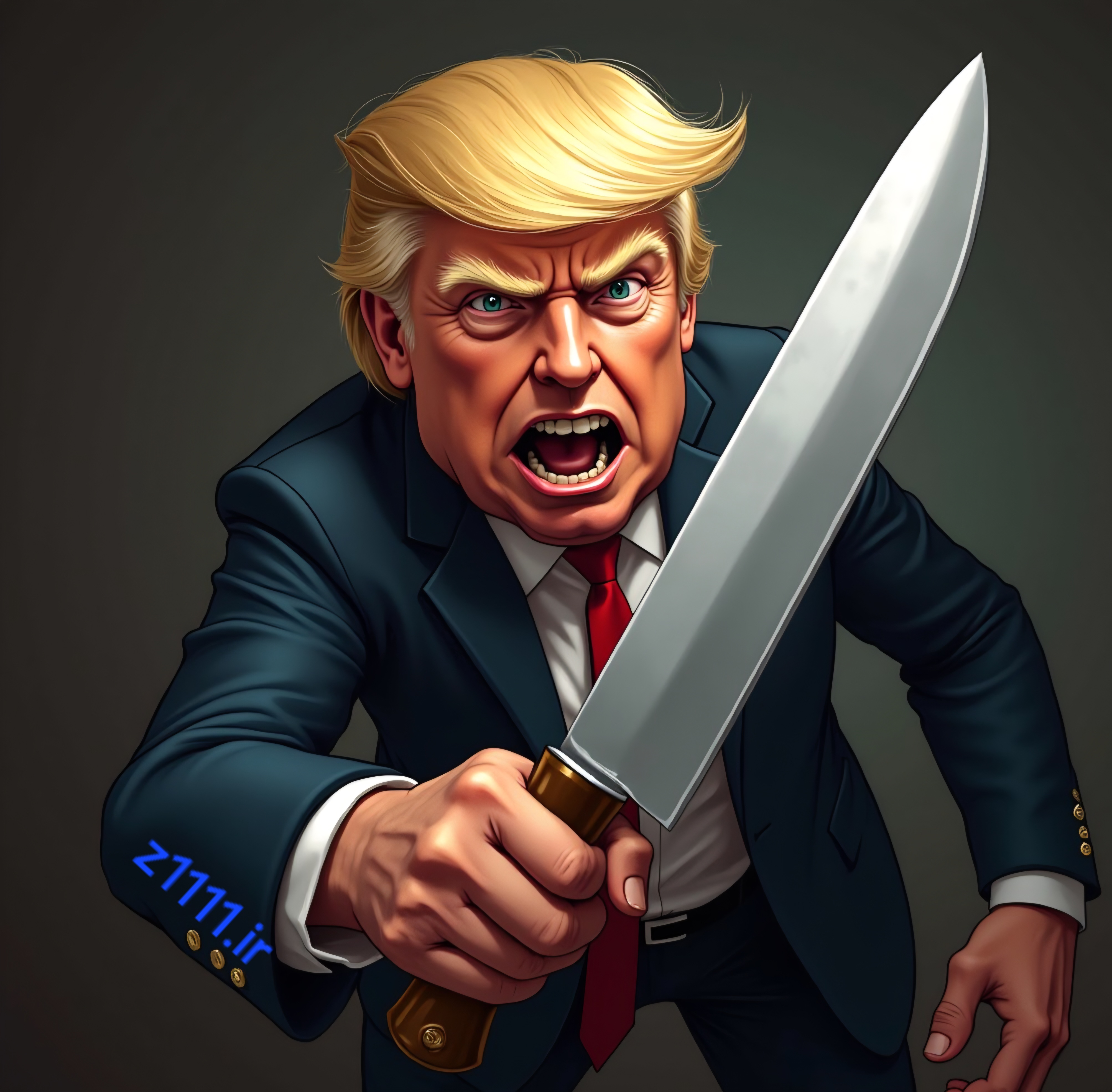
In old Tehran, among knife-wielding neighborhood bullies, there was an unwritten rule: as long as the knife stayed in the pocket, there was still a chance for the fight to be settled by a local tough or a respected elder. But the moment the bully pulled out the knife, to preserve his reputation he had to strike; backing down without cost was no longer possible.
If he failed to strike, his aura would collapse forever. Sometimes, he would even wound himself—just to avoid humiliation.
Sending an aircraft carrier, in the logic of thug-style power and recklessness, is exactly the same as pulling out the knife. With this move, Trump has entered a stage where neither striking nor refraining is safe for him.
If he takes military action, Iran’s response is inevitable—a response that will not necessarily be symmetrical, nor confined to one geography. The scope of confrontation would spiral out of control, and costs would rapidly spread from the military domain to the economy, domestic politics, and America’s global credibility.
And if he refrains and settles for mere posturing, he clearly broadcasts weakness and erodes his own deterrent credibility. Both paths are costly.
Moreover, an aircraft carrier is not merely a weapon of war for the United States; it is a symbol of a worn-out empire’s power. Even a credible threat against this symbol paralyzes Washington’s calculations, because damage to it means the collapse of a myth. For this reason, the U.S. can neither accept the risk of real confrontation nor openly retreat. This situation is the very definition of a strategic deadlock.
The absence of international consensus and the growing distance of Europe—an already declining Europe struggling with its own crises—has deepened this deadlock. In this adventure, the United States is effectively alone, and pressure without political backing reveals the weakness of the one applying it more than it weakens the opponent.
The reality is that Trump’s initial goal from this naval deployment was to create fear. But signs now indicate that not only has no fear been generated, he is facing an Iran that is more prepared, calmer, and more cohesive. In such conditions, searching for a way back is the most natural reaction.
In the language of old Tehran:
The knife is out, but its owner knows well—if he strikes, he gets caught; if he doesn’t, he collapses.
And this is exactly the moment when the game is already lost—before the shot is fired.
These lines are also addressed to those who, at the sound of warships, were the first to reach for their calculators—those who see threats not as a means to understand the balance of power, but as an excuse to flee into an agreement at any price.
Fear is not a tool of analysis. Foreign policy does not move forward with a trembling hand. If a cost must be paid, it is the nation that pays it—not the negotiating table.
So do not make decisions for a nation based on personal fear.
And a note to the West-struck:
War is not a ladder of progress; it is a mill.
And in this arena, the one who imagines he will climb over the rubble is usually the first to be buried beneath it.
Trump is neither a savior nor an opportunity; and in this grave you are mourning over, there is no dead man waiting to be resurrected.
The Islamic Republic of Iran is powerful, calm, and prepared.
And before such a nation, any aggressive aircraft carrier is less a tool of threat than a passing boat in the waters of the eternal Persian Gulf.
S.M.R

١- بلحاظ قانونی هر فرد مسئول محتوای نظر ارسالی خود است ،که از طریق قانون با آی پی شناسایی و پيگيرى می شود